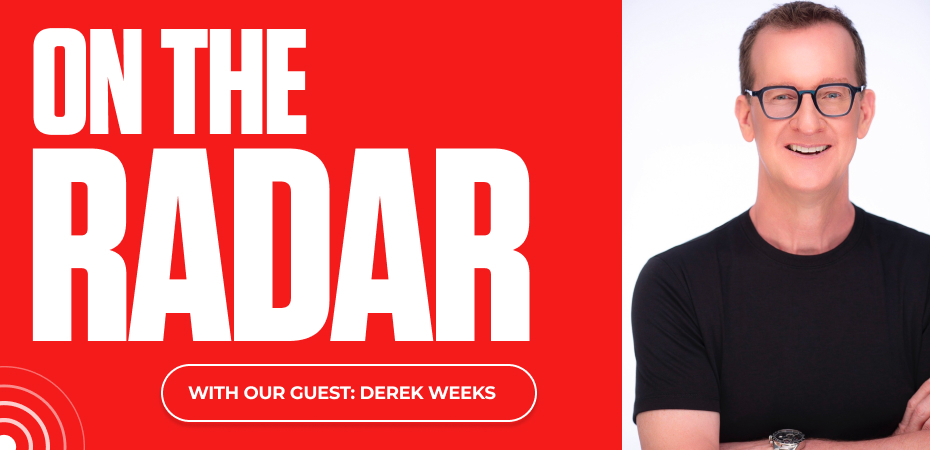
AI is forcing marketers to rethink how they work, but Derek Weeks believes the most important shifts are happening at the intersection of technology, creativity and execution.
As SVP of Marketing at Anaconda, a company whose Python platform supports much of today’s AI development ecosystem, Weeks spends his days thinking about how AI is changing the way organizations build, market and scale. His perspective goes beyond prompts and productivity hacks. He’s interested in what happens when marketers begin using AI to create new workflows, solve problems themselves and rethink long-held assumptions about how work gets done.
Ahead of REQ’s upcoming webinar, AI Unleashed: How Today’s Marketers Are Redefining Creativity, Scale & Impact, we spoke with Weeks about agentic AI, the future of marketing teams and why marketers need to start thinking like builders.
Q: You shared a story about hitting Claude’s token limits while using AI agents to build a report over a weekend. What stood out to you about that experience?
The report itself wasn’t the interesting part.
What caught my attention was how quickly an idea moved from concept to execution. I had multiple agents working simultaneously on research, analysis and content development. By the time I shared it with my team, the reaction was, “When did this happen?”
Most marketing organizations have built processes around the assumption that certain kinds of work take a certain amount of time. AI starts to challenge those assumptions. When you can compress days or weeks of work into a much shorter timeframe, it changes how you think about planning, collaboration and execution.
It also forced me to think differently about the economics of AI. I hit my token limits because I was running so many agent-based workflows. At a certain point, you start asking whether every task needs to be processed in the cloud.
Q: How are you optimizing your LLM workloads?
I think we’re going to see more AI workloads move to the edge. Right now, many people assume every AI task should go to OpenAI, Anthropic or another cloud provider. That works, but it also means you’re constantly consuming tokens and paying for compute that may not be necessary.
The analogy I use is solar panels. If you have solar panels on your house, you still use the utility company when you need it, but you don’t want every watt of electricity coming from the grid. I think AI will evolve in a similar way.
There will always be workloads that require large cloud-based models, but there are plenty of tasks that can be handled locally on a laptop using smaller models. As those capabilities improve, marketers will have more options for deciding where work happens and what it costs.
Q: You’ve said marketers need to become builders. What does that mean in practice?
For most of my career, marketing teams have been organized around specialization. If you had an idea, there was usually a handoff involved. You might need a developer, an operations person, an analyst or somebody else to help bring that idea to life. AI is reducing some of those barriers.
I’m seeing more marketers who can identify a problem and then build a solution themselves. It may be a workflow, a research process, a content engine or an agent that helps automate part of their job. They don’t necessarily have traditional technical backgrounds, but they’re increasingly comfortable creating things instead of waiting for someone else to create them.
That’s where the idea of “vibe coding” becomes interesting. It’s not about turning marketers into software engineers. It’s about giving them the ability to build useful things without needing to master every technical detail underneath.
Q: How is AI affecting the way you evaluate talent?
Experience matters more than people sometimes assume. I would rather hire a senior marketer who understands AI than a junior marketer who understands AI. The technology can help accelerate execution, but experience helps you understand what questions to ask and what outcomes you’re trying to achieve.
The people who are getting the most value out of AI are usually the ones who already have strong domain expertise. They know what good looks like and they have better intuition on which tasks could be accomplished through agents and prompts. AI helps them get there faster.
Q: What should marketing leaders be focused on right now?
Curiosity and experimentation. The companies that will benefit most from AI are the organizations that encourage people to test ideas, share what they’re learning and challenge old assumptions about how work gets done.
Most of us are still figuring this out in real time. The advantage goes to the teams that are learning faster than everyone else.
Want to hear more from Derek?
Derek Weeks will join Nate Burke, CMO of 7AI, and Melissa Beck, VP of Corporate Marketing at Sumo Logic, for REQ’s upcoming webinar, AI Unleashed: How Today’s Marketers Are Redefining Creativity, Scale & Impact, on June 12.
The discussion will explore how marketing leaders are using AI to scale content creation, improve efficiency, evolve team workflows and balance human creativity with machine intelligence.
Register today to hear Derek’s perspective on agentic AI, marketing leadership and why the next generation of marketers will need to think like builders.