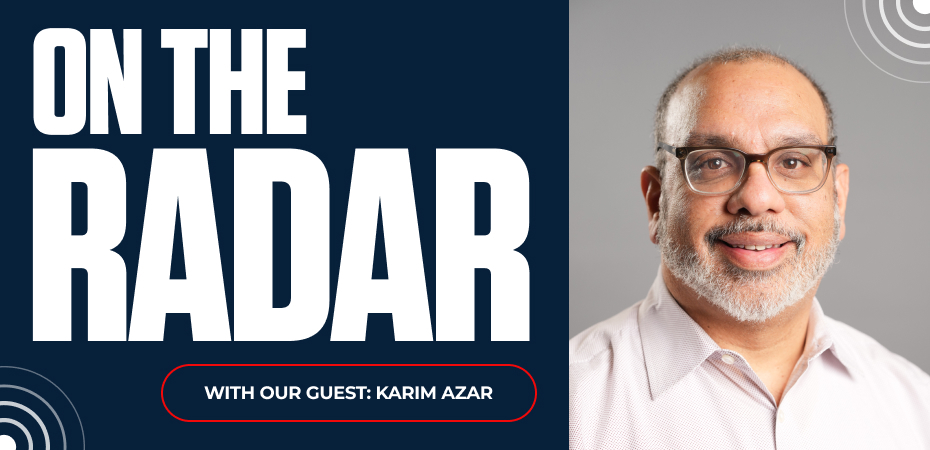
For years, B2B marketers have been pushed toward bottom-of-funnel tactics that promise measurable, immediate results. Karim Azar went in the opposite direction.
As Senior Director of Global Digital and Web Marketing at Reltio, Azar helped transform the company’s approach to demand generation by moving away from bottom-of-the-funnel marketing and investing more heavily in awareness and account engagement. Since making the risky move, the strategy has become a cornerstone of Reltio’s growth and helped earn the company Forrester’s ABM Program of the Year recognition and a Killer Content Award from B2BMX.
We spoke with Azar about why Reltio made the shift and what happened when the company invested more heavily in awareness.
Q: Reltio plays in a pretty hot space. Can you describe what the company does?
Karim Azar:
Reltio is a context intelligence platform rooted in master data management. We help enterprises unify, cleanse and enrich data that’s spread across dozens of systems so they can create a trusted foundation for AI.
As AI has become a bigger priority, that’s become even more important. AI is only as good as the data behind it. Our job is to bring context and trusted information together across the organization so AI can deliver meaningful outcomes for employees and customers.
Q: A few years ago, you shifted spending toward awareness rather than doubling down on conversion tactics. Why?
Azar:
We’re selling enterprise software with a long sales cycle and a high six-figure to low seven-figure average annual deal size. Not one person puts something like that on a credit card.
So, we decided to stop thinking about individual leads and start thinking about creating broader awareness so that when our BDR team reached out, they weren’t calling into cold accounts. They were calling into a primed audience.
Q: How did that come about, and were you nervous about making the change?
Azar:
Absolutely. It was risky, and we weren’t sure it would work, but we had to try.
It started with me scheduling a meeting with my boss and titling it, “I’m about to blow up our paid media.” I walked in and said, “Here’s how we’re doing things today. Here’s the new funnel we’ve built. And the two don’t align.”
We had invested a lot of time in redesigning how opportunities would move through our funnel, but our marketing programs were still optimized for the old way of measuring success. So, we restructured our campaigns, reworked our go-to-market approach and aligned everything to the metrics we cared about. We changed our spend mix from 80% focused on conversion and 20% on awareness activities to 80% focused on awareness and thought leadership and 20% on conversion.
Q: How did you know the strategy was working?
Azar:
At the very top of our funnel, we have two stages: suspect and detected. When we started this process, about 90% of our opportunities were sitting in the suspect stage. Six months later, roughly 90% had moved into detected. That was a huge signal that we were creating awareness and interactions inside the accounts we cared about.
Once we saw that shift, the conversation became, “Okay, how do we move them to the next stage? And then the stage after that?” That’s really how we’ve approached the entire funnel. You don’t turn things off; you start at the top, build momentum and keep moving opportunities through the system.
The other thing we learned was how much awareness improves everything else. As we invested more in our brand, our conversion programs got better. We were spending less money in places like Google and Bing, but we weren’t losing volume. We were getting better-quality engagement throughout the funnel.
Now, every quarter is a record quarter from a qualification pipeline perspective. The volume is bigger than what we used to generate, and it’s converting at a much higher rate. What used to have a 1% conversion from qualification to revenue is now converting at 18%.
Q: What surprised you most after making the shift?
Azar:
Obviously, the success has been a pleasant surprise. But what surprised me most was how much more fun marketing became. We moved away from simply optimizing conversion campaigns and chasing form fills. Instead, we were able to invest more in our brand and create programs that generated awareness and engagement.
Most companies our size struggle to justify brand spend because it’s hard to tie directly to ROI. What surprised us was that we could actually see the impact.
Q: What advice would you give marketers who are still heavily focused on bottom-of-funnel tactics?
Azar:
If you’re going to make a shift like this, you need a clear plan and metrics that align with what you’re trying to achieve. Then, you need to make sure marketing, sales and leadership are all aligned around those goals. It was our collaboration as a GTM team that drove this change. We strived for more than just “agreement”; we dared to have alignment.
Finally, you need to continually communicate what you’re doing, why you’re doing it, and how it connects to the metrics that matter. Once everyone understands the plan, it becomes much easier to get buy-in, stay the course, and succeed.