Using Adobe Analytics for Organic Search Keyword Reporting

by

• Article

3–5 minutes

read

With Google now limiting access to organic search keyword referral data, advertisers who use Adobe Analytics can no longer rely on Adobe’s standard natural search reports to identify the keywords that visitors use to enter the site. While Adobe Analytics still reports natural search terms from Bing and other engines, the gap left by the excluded Google data is significant and not usually covered by data from other sources.

The following sample Adobe Analytics natural search report is filtered to show only Google referrals. Notice that more than 80% of the organic search referrals are categorized as ‘keyword unavailable,’ and data is provided for only a few specific keywords.
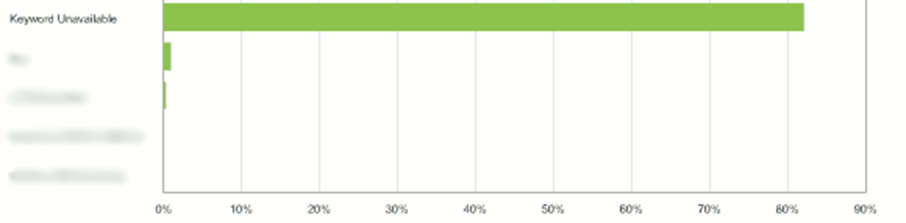
Adobe Analytics Keyword Unavailable

To work around this limitation, Google recommends using data from Google Webmaster Tools, internal search, paid search and web analytics, including landing page popularity and traffic flow. To approximate the data in Adobe Analytics, you can use two reports: the Internal Search and Paid Search reports.

Internal Search Report

Adobe Analytics tracks internal search keywords using processing rules to populate the Internal Search Terms eVar values. The keywords can then be analyzed to determine which terms are associated with conversions. You may want to optimize your content for these keywords to help increase conversions.
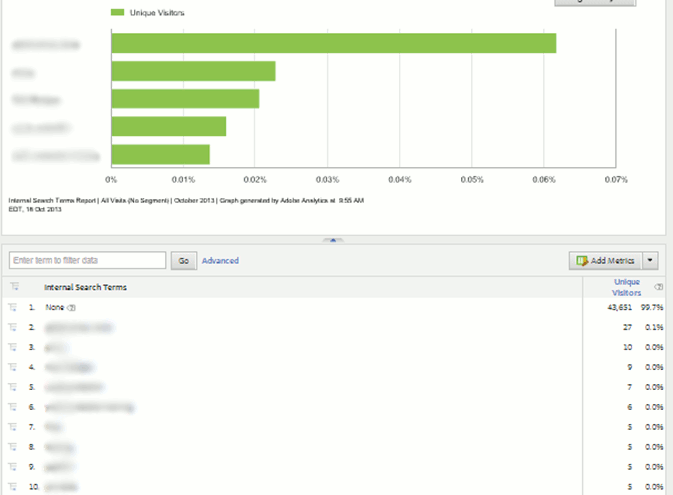
Analytics | Internal Search Report

Paid Search Report

Whereas Google AdWords automatically passes PPC keyword data to Google Analytics, this encrypted data is not automatically reported in Adobe Analytics. However, through campaign tagging you can track detailed PPC visit data including the campaign, ad group, ad and associated keyword. This ability to classify detailed campaign data is one benefit of Adobe Analytics over Google Analytics.

In campaign tagging, the cid parameter is added to destination URLs to identify the source (i.e., Google AdWords), campaign and other factors. For example, the following URL contains a cid value of ga45. In this case, GA indicates that this destination URL is specific to Google AdWords. The 45 could indicate the specific campaign and ad copy.

http://www.mysite.com?cid=ga45

Adobe Analytics reads the URL, retrieves the campaign tag and value, and associates it with the visitor. The visit is then classified using the Classification Rule Builder or Classification Importer. To provide keyword analytics, include the keyword bid on in AdWords (i.e., furniture sale) in the classification.

Note: While Adobe Analytics report the associated keyword for a PPC visit, it does not report the actual keyword entered. To find this data, view the keyword details report in Google AdWords.

Campaign Tagging

A set of campaigning tagging rules can be established using the Adobe Analytics Classification Rule Builder. Advertisers can create their campaign tracking codes on the fly using a formula created for their organization. Adobe Analytics requires a uniquely tagged URL for every PPC keyword (or ad) by search engine, account and campaign. Typically someone on the analytics or paid search team creates the parameters, which are appended to keyword-level destination URLs. This process is initially time-consuming but provides granular paid search data.

You can include in the cid parameter value any number of expressions that indicate the associated channel, campaign, keyword, region, language, agency and more. The table below shows a sample set of classification rules that could be used to create cid parameters for a specific campaign.

Expression Possible Values Meaning
Channel GA
BA
Google Analytics
Bing Ads
Campaign FF
SF
Fall Furniture campaign
Spring Furniture campaign
Keyword keyword Furniture sale
Region C
N
Connecticut
New York
Language E
F
English
French
Agency R RepEquity


The cid parameter would include these expressions separated by colons (:).

cid=outlet:campaign:region:keyword:LanguageAgency


Using the above set of campaign tagging rules, the following parameter value indicates that this visit came from Google AdWords for the Fall Furniture campaign. The keyword searched was ‘furniture sale’ in English. The ad was managed by RepEquity.

cid=GA:FF:C:furniture_sale:ER

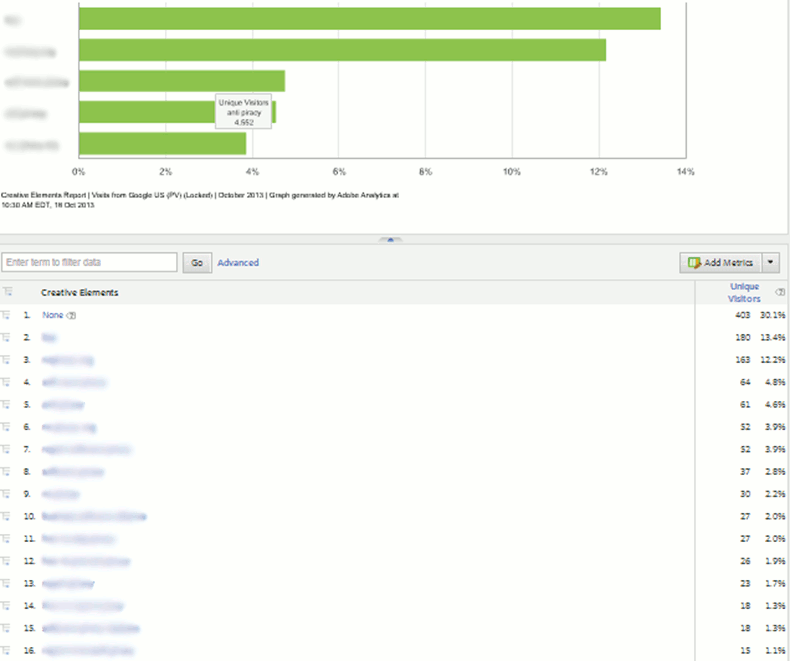
The Classification Rules Builder compiles this data in the Campaign Reports. A sample report is shown below.
Analytics | Internal Search Report

Companies that do not run paid search campaigns can still use Adobe’s Internal Search reports and limited data available in the Natural Search reports to analyze organic search keyword patterns. For these brands, we recommend running at least a small (two to three month) PPC test to gather keyword intelligence. For companies that have never run any PPC campaigns, a test can also help determine the effectiveness of paid search. The results may lead to further PPC testing or a longer term campaign, plus greater insight into keyword usage.

If you have questions about your analytics or search engine optimization (SEO), drop us a line. We’re happy to help.
The CMO Who Gave Up Sales Pitches to Build Real Relationships

The CMO Who Gave Up Sales Pitches to Build Real Relationships

Chatting with Nathan Burke of 7AI on why relationship-building outperforms traditional B2B marketing Nathan Burke is intentionally doing less of what most B2B marketers are taught to do. As CMO of 7AI, he’s opting out of the usual B2B playbook, the awkward steak dinners with a pitch attached, the conference badge scanning arms race, and…

How UVEye’s Unicorn Drives Trade Show Excitement

How UVEye’s Unicorn Drives Trade Show Excitement

Trade shows are crowded. Competitive. Expensive. Every booth promises innovation. Every brand is trying to stand out to the sea of overwhelmed and tired attendees. For AI-driven vehicle inspection company UVEye, standing out meant not just thinking creatively. It meant creating a unicorn. UVEye calls its technology an “MRI for cars.” It provides AI-driven technology that…

How WalkMe’s Melanie Pasch Humanized the Enterprise AI Adoption Problem with “AI Shame”

How WalkMe’s Melanie Pasch Humanized the Enterprise AI Adoption Problem with “AI Shame”

Ask an executive how many software applications their company uses, and they’ll probably guess 30 or 40. The average organization, according to research by digital adoption platform (DAP) pioneer WalkMe, actually runs about 625 applications. This staggering digital ecosystem is where most tech investments stall, not because the technology is poor, but because employees can’t…

From $200M ARR to Pre-Seed: How Karina Lawrence Rewrites the Marketing Playbook for Early-Stage Startups

From $200M ARR to Pre-Seed: How Karina Lawrence Rewrites the Marketing Playbook for Early-Stage Startups

When you’ve helped scale a developer-focused company from roughly $200M to nearly $250M in ARR, you know what “grown-up” marketing looks like. Today, though, Karina Lawrence is back at the very beginning—leading marketing at Macrovo, a pre-seed, ~10-person startup that blends AI and human expertise to help financial institutions make faster, smarter decisions. It’s a…

B2B Videos You Actually Want to Watch? Meet Jared Evers of Medallia.

B2B Videos You Actually Want to Watch? Meet Jared Evers of Medallia.

For Jared Evers and his small and scrappy content team at Medallia – provider of customer and experience software – if you can’t do something stellar, there’s no sense in doing it at all. For proof, check out how the team is pushing the boundaries of corporate videos with Experience Now, Medallia’s own streaming platform.…

How HII’s Jaime Orlando Builds Connection, Culture, and Momentum Inside a Legacy Brand

How HII’s Jaime Orlando Builds Connection, Culture, and Momentum Inside a Legacy Brand

Q: Jaime, for those who might not know HII Mission Technologies, can you give us a quick overview of what your team does? Jaime Orlando Absolutely. HII as a company has an incredible legacy. It’s America’s largest shipbuilder, with more than 135 years of experience. About 75% of HII’s business comes from shipbuilding at our…

How Jenifer Kern Helped Qu Redefine Restaurant Tech

How Jenifer Kern Helped Qu Redefine Restaurant Tech

On the Radar sat down with Jenifer Kern, CMO of Qu, to talk about how she helped create a new category in restaurant technology, why maintaining industry focus has been key to business growth, and what it means to elevate marketing in a longstanding industry undergoing rapid transformation. Q: When you joined Qu, what did the industry…

From The New York Times to Muck Rack: Linda Zebian on Knowing What’s Newsworthy

From The New York Times to Muck Rack: Linda Zebian on Knowing What’s Newsworthy

Linda Zebian knows how to tell a good story. As VP of Communications at Muck Rack, she leads a lean, high-impact team responsible for brand, content, product marketing, internal comms, and more. Her approach is grounded in the instincts she developed over 10 years in corporate comms at The New York Times, where she learned…

How Sam Baldridge is Turning Culture Into a Competitive Edge

How Sam Baldridge is Turning Culture Into a Competitive Edge

At Applied Systems, Sam Baldridge wears a lot of hats. Officially, she’s the Senior Communications and Culture Specialist. Unofficially, she might be better known as the “Vibes Director.” Sam is part of a small but mighty three-person team tasked with building internal connection, shaping employer branding, and turning culture into a competitive advantage.  We caught…

How Kristina McConnell Uses Precision and AI to Power Account-Based Marketing at H1

How Kristina McConnell Uses Precision and AI to Power Account-Based Marketing at H1

A Director of Marketing at H1, Kristina McConnell brings structure, creativity, and a test-and-learn mindset to every campaign she touches. With a small team and a niche audience in the pharma space, she has helped transform H1’s account-based marketing (ABM) approach into a tightly aligned, data-driven engine. Her team goes far beyond basic alignment with sales.…

CONTACT US
CONTACT US

WE HELP BRANDS OWN WHAT’S NEXT

Our integrated PR and digital campaigns build reputations, drive growth, and shape conversations that define markets. Let’s talk about how we can help you do the same.