Google Analytics Settings are Changing. Don’t Be Caught Off Guard.

by

2–3 minutes

read

Google has a set of newly established settings to help you specify how long your user-level and event-level data should be stored by Google Analytics. They’re called Data Retention Settings and the default action is to expire (delete) your detailed data after 26 months. Aggregated (summary) data is unaffected by this change.

The default is likely more than sufficient for most reporting scenarios but there are situations in which you might want to reduce or extend this timeframe.

You should extend this timeframe if you want to use the Google Analytics interface to provide detailed data for more than two years in your reports. We rarely need reports from Google Analytics beyond two years, so extending the default may not be necessary in most instances.

For those situations in which you do want to retain data on individual usage scenarios and actions for longer than two years, it is easy to go into the Data Retention Settings and extend the period.

Google is implementing this change on May 25, 2018. The settings can take up to 24 hours to take effect. This means it is important to adjust these settings prior to May 24, 2018, to retain existing data.
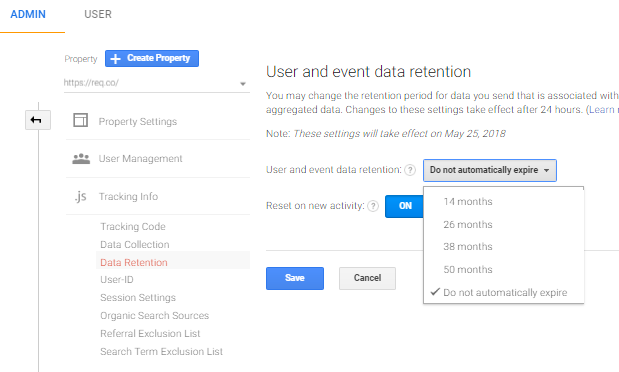
Admin Dashboard

Why Would I Let Data Expire?

Data expiration is important to support end-user privacy and is an element under the European Union GDPR. And while Google Analytics does not permit the capture of personally identifiable information (PII) the elimination of user-level path data, even if it is unassociated with an identifiable individual, is supportive of the spirit of the GDPR.

What Alternatives Do I Have?

It is easy enough to set the Data Retention timeframe to Do Not Automatically Expire. Under that setting, nothing will expire in Google Analytics. We expect this to be the most commonly used setting scenario. Alternatives include the exporting of data from Google Analytics into other tools. Google Sheets, SuperMetrics, Tableau, Microsoft BI, and many other business intelligence tools connect to Google Analytics as a data source. This enables the extraction of a wealth of data. Be sure that the storage and retention of this data complies with your privacy policy and GDPR compliance rules.

You may also elect to use an alternative analytics package that offers more control of your data. REQ frequently utilizes Matomo (formerly PiWik), which provides no limits to data retention and supports storage of data within our own databases. We then ensure data is archived or deleted based upon clients’ data retention and privacy policies.

The Future

Google’s move to provide the ability to expire data is not unexpected. In fact, it’s quite similar to the practices of other analytics frameworks such as Adobe Analytics. Expect to see similar policies being put into place by any service that collects and measures individual user data and traffic information.

Read more Google Analytics Data Retention at: https://support.google.com/analytics/answer/7667196?hl=en
The CMO Who Gave Up Sales Pitches to Build Real Relationships

The CMO Who Gave Up Sales Pitches to Build Real Relationships

Chatting with Nathan Burke of 7AI on why relationship-building outperforms traditional B2B marketing Nathan Burke is intentionally doing less of what most B2B marketers are taught to do. As CMO of 7AI, he’s opting out of the usual B2B playbook, the awkward steak dinners with a pitch attached, the conference badge scanning arms race, and…

How UVEye’s Unicorn Drives Trade Show Excitement

How UVEye’s Unicorn Drives Trade Show Excitement

Trade shows are crowded. Competitive. Expensive. Every booth promises innovation. Every brand is trying to stand out to the sea of overwhelmed and tired attendees. For AI-driven vehicle inspection company UVEye, standing out meant not just thinking creatively. It meant creating a unicorn. UVEye calls its technology an “MRI for cars.” It provides AI-driven technology that…

How WalkMe’s Melanie Pasch Humanized the Enterprise AI Adoption Problem with “AI Shame”

How WalkMe’s Melanie Pasch Humanized the Enterprise AI Adoption Problem with “AI Shame”

Ask an executive how many software applications their company uses, and they’ll probably guess 30 or 40. The average organization, according to research by digital adoption platform (DAP) pioneer WalkMe, actually runs about 625 applications. This staggering digital ecosystem is where most tech investments stall, not because the technology is poor, but because employees can’t…

From $200M ARR to Pre-Seed: How Karina Lawrence Rewrites the Marketing Playbook for Early-Stage Startups

From $200M ARR to Pre-Seed: How Karina Lawrence Rewrites the Marketing Playbook for Early-Stage Startups

When you’ve helped scale a developer-focused company from roughly $200M to nearly $250M in ARR, you know what “grown-up” marketing looks like. Today, though, Karina Lawrence is back at the very beginning—leading marketing at Macrovo, a pre-seed, ~10-person startup that blends AI and human expertise to help financial institutions make faster, smarter decisions. It’s a…

B2B Videos You Actually Want to Watch? Meet Jared Evers of Medallia.

B2B Videos You Actually Want to Watch? Meet Jared Evers of Medallia.

For Jared Evers and his small and scrappy content team at Medallia – provider of customer and experience software – if you can’t do something stellar, there’s no sense in doing it at all. For proof, check out how the team is pushing the boundaries of corporate videos with Experience Now, Medallia’s own streaming platform.…

How HII’s Jaime Orlando Builds Connection, Culture, and Momentum Inside a Legacy Brand

How HII’s Jaime Orlando Builds Connection, Culture, and Momentum Inside a Legacy Brand

Q: Jaime, for those who might not know HII Mission Technologies, can you give us a quick overview of what your team does? Jaime Orlando Absolutely. HII as a company has an incredible legacy. It’s America’s largest shipbuilder, with more than 135 years of experience. About 75% of HII’s business comes from shipbuilding at our…

How Jenifer Kern Helped Qu Redefine Restaurant Tech

How Jenifer Kern Helped Qu Redefine Restaurant Tech

On the Radar sat down with Jenifer Kern, CMO of Qu, to talk about how she helped create a new category in restaurant technology, why maintaining industry focus has been key to business growth, and what it means to elevate marketing in a longstanding industry undergoing rapid transformation. Q: When you joined Qu, what did the industry…

From The New York Times to Muck Rack: Linda Zebian on Knowing What’s Newsworthy

From The New York Times to Muck Rack: Linda Zebian on Knowing What’s Newsworthy

Linda Zebian knows how to tell a good story. As VP of Communications at Muck Rack, she leads a lean, high-impact team responsible for brand, content, product marketing, internal comms, and more. Her approach is grounded in the instincts she developed over 10 years in corporate comms at The New York Times, where she learned…

How Sam Baldridge is Turning Culture Into a Competitive Edge

How Sam Baldridge is Turning Culture Into a Competitive Edge

At Applied Systems, Sam Baldridge wears a lot of hats. Officially, she’s the Senior Communications and Culture Specialist. Unofficially, she might be better known as the “Vibes Director.” Sam is part of a small but mighty three-person team tasked with building internal connection, shaping employer branding, and turning culture into a competitive advantage.  We caught…

How Kristina McConnell Uses Precision and AI to Power Account-Based Marketing at H1

How Kristina McConnell Uses Precision and AI to Power Account-Based Marketing at H1

A Director of Marketing at H1, Kristina McConnell brings structure, creativity, and a test-and-learn mindset to every campaign she touches. With a small team and a niche audience in the pharma space, she has helped transform H1’s account-based marketing (ABM) approach into a tightly aligned, data-driven engine. Her team goes far beyond basic alignment with sales.…

CONTACT US
CONTACT US

WE HELP BRANDS OWN WHAT’S NEXT

Our integrated PR and digital campaigns build reputations, drive growth, and shape conversations that define markets. Let’s talk about how we can help you do the same.