Inside the Headlines: What’s Next In Government IT Media

Government IT coverage is entering a pivotal moment—defined by workforce disruption, evolving acquisition strategies, and a growing demand for proof over promise. 

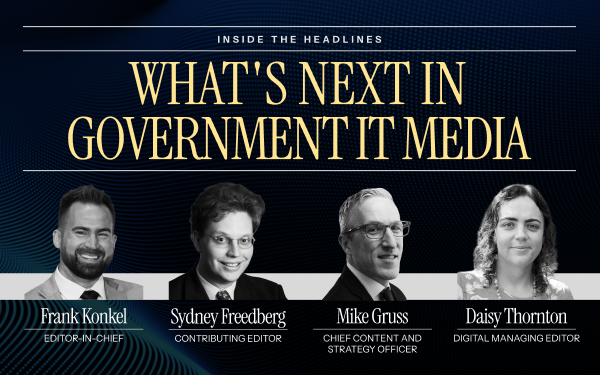
That was the clear takeaway from our recent webinar, Inside the Headlines: What’s Next in Government IT Media. Moderated by Katie Hanusik, PR Practice Lead at REQ, the conversation brought together Frank Konkel (Editor-in-Chief, GovExec), Sydney Freedberg (Contributing Editor, Breaking Defense), Mike Gruss (Chief Content & Strategy Officer, SpaceNews), and Daisy Thornton (Digital Managing Editor, Federal News Network). Together, they unpacked the stories that resonated most in 2025 and what those signals reveal about the government IT media landscape heading into 2026.

From record federal IT spending and workforce reductions to AI’s long-awaited “prove it” moment, the discussion offered a candid look at how journalists are assessing credibility, relevance, and impact in today’s coverage.

Key Takeaways from the Discussion

1. AI is moving from hype to accountability

Panelists agreed that 2025 was dominated by AI excitement—but 2026 will be about outcomes. As Daisy Thornton put it, “2025 was all about hype. In 2026, we want to start getting into the weeds… We want to start seeing metrics. We want to start seeing the ROI…or talk to us about what you’ve learned and how you’re pivoting.” Journalists are looking for concrete metrics, real-world use cases, and voices from program managers and federal operators—not abstract promises of productivity.

Sydney Freedberg reinforced that skepticism, noting that not all AI use cases are created equal. “AI seems to be really good for summarizing huge masses of material that no one really should have to read in the first place,” he said—but far less proven when it comes to complex decision-making. For journalists, the distinction matters: AI stories gain traction when they show clear, mission-specific value rather than broad claims of transformation. Demonstrating cost savings, time savings, or mission impact will stand out far more than broad claims.

2. Federal spending tells a more complex story than headlines suggest

Despite the focus on efficiency and cost-cutting, Konkel highlighted a surprising reality: “The government actually spent an all-time record in contract spending.” This underscores a major disconnect between public perception and fiscal reality.

Mike Gruss reinforced that budgets aren’t just numbers—they’re signals. For reporters covering space and defense, understanding where funding is flowing—and where it’s slowing—is central to helping readers anticipate what comes next.

The implication for vendors and communicators is clear: spending hasn’t disappeared—it’s being reprioritized toward areas like defense, cybersecurity, AI, and emerging technologies.

3. Workforce constraints are shaping every beat

Across civilian and defense coverage, workforce reductions emerged as a central tension. With roughly 300,000 fewer federal employees, agencies are being forced to do more with less—often without clear answers on how. Thornton described workforce pressures as “the elephant in the room in pretty much every conversation,” particularly for IT and cybersecurity teams. This dynamic is shaping how journalists evaluate technology claims, especially those positioned as workforce substitutes rather than enablers.

Several panelists also noted that while workforce reductions are real, agencies are beginning to experiment with targeted ways to bring technical talent back in. Frank Konkel pointed to early efforts like TechForce, which aim to reintroduce specialized technology expertise after broad reductions in force. As he noted, time will tell whether these initiatives can offset staffing gaps, but the push reflects a recognition that emerging technologies—particularly AI—still require skilled people behind them to deliver results.

4. Acquisition reform and major procurements will drive 2026 coverage

From the Pentagon’s AI Action Plan to massive contracts like JWCC follow-ons and the Golden Dome program, acquisition reform is becoming a defining storyline. While often seen as “unsexy,” Konkel argued it may be “the most important topic to watch over the next year or two” because of its potential to reshape how the government buys technology at scale as the administration focuses on speed and outcome-based contracting.

Gruss noted that journalists will be watching not just who is awarded contracts, but how those contracts are structured. That shift is on full display in the Golden Dome program. Gruss described it as a “once-in-a-generation infusion” of funding—but one that signals a new model for execution. “This isn’t really a program about innovation,” he said. “This is a building program—trying to put together pieces that already work.”

Together, these dynamics point to an acquisition landscape where partnerships, execution, and measurable impact matter more than announcements—and where programs like Golden Dome are paving a new path for how major government IT initiatives are structured and covered.

5. For media engagement, credibility beats marketing

When it comes to working with journalists, the panel offered consistent advice: know the audience, avoid jargon, and focus on real problems solved. Sydney Freedberg summed it up bluntly: generic pitches that promise AI will “make everything times better” don’t land. What does? Evidence, domain expertise, and customer voices that demonstrate actual impact.

Looking Ahead

As government IT priorities evolve, so too does the media lens examining them. For vendors, communicators, and policymakers alike, the message from this panel was clear: substance matters more than spin. In 2026, the stories that break through will be those grounded in data, context, and real-world outcomes—told by voices that understand both the mission and the moment.

To learn more or revisit the conversation, head over to the REQ YouTube channel where you can find a recording of the discussion or take a look at our recent whitepaper Public Sector AI: What the Media is Covering and How to Drive the Conversation.

Stay tuned for more insights from REQ as we continue to track what’s shaping government technology—and the headlines that follow. Our team is here to answer any questions you may have along the way.

Let’s talk.

Name