The State of Search: BERT

by

3–4 minutes

read

On October 25, 2019, Google announced the release of its most recent algorithm update, BERT. 

What is BERT? 

BERT, which stands for Bidirectional Encoder Representations from Transformers, is Google’s neural network-based technique for natural language processing (NLP) pre-training. This technology was first introduced last year and has been used to help computers better understand natural language. 

When applied to search, BERT helps better interpret and understand the context of users’ queries in order to provide more relevant search results in Google. At this time, BERT has only been rolled out in the United States, in English, but it will extend to other countries and languages in the future. However, when it comes to populating featured snippets, BERT is being used globally and across all languages.

How BERT Works in Real Life

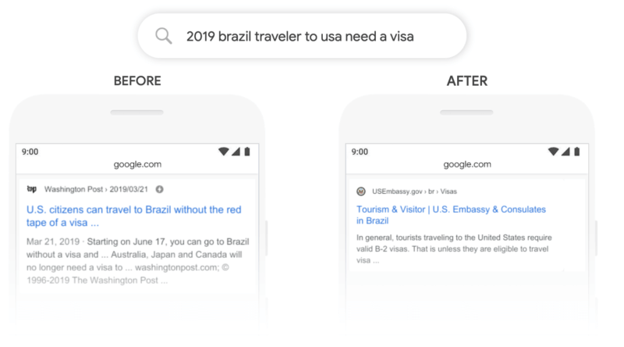
See the example shared by Google, below. For the query “2019 brazil traveler to usa need a visa”, BERT helps Google understand the role of the word “to” in this particular query:
REQ Google October Algorithm Update PERT

Prior to BERT, Google would return a news article that references U.S. citizens traveling to Brazil in the top position but after BERT has rolled out, Google returns the Tourism & Visitor page of the U.S. embassy in Brazil site which shares much more relevant information that better matches the searcher’s intent with this query. 

Kind of a Big Deal

While not the largest Google update we have seen to date, the BERT update does represent “the biggest leap forward in the past five years, and one of the biggest leaps forward in the history of Search”, according to Google.

What Does this Mean for Us? 

BERT will impact 1 in every 10 search queries made in Google, which is significant. Google’s Danny Sullivan reassured the search community that there is nothing we need to change or do differently on our client sites in relation to this update. He went on to say that “There’s nothing to optimize for with BERT, nor anything for anyone to be rethinking. The fundamentals of us seeking to reward great content remain unchanged.” 

Based on the way Google explains the functionality of BERT, our search engine optimization team will closely monitor organic traffic, reevaluate the search landscape of our clients’ priority keywords, and focus on better matching site content with the user intent of target keywords. In addition, producing quality content that fully satisfies users’ queries continues to remain top of mind.

Additional Industry News & Useful Links

  1. October 14-19: SERPs experienced some volatility during this time which was likely due to Google making tweaks to its September 2019 Core update

  2. October 16: Google confirmed that it was having issues indexing new content but fixed this issue by the end of the day.

  3. October 25: Google BERT update announced. BERT stands for Bidirectional Encoder Representations from Transformers and is a new way for Google to better understand language and context to improve search results in the US in English (it will come to more countries and languages in the future). Take a look at Google’s blog post for more information on BERT.

  4. Google announced that it updated its accessibility guidelines for making site images more accessible. Check out the updated guidelines here.

  5. There is new structured data available to appear in Google Assistant searches. The types of content that are supported by this new structured data include podcasts, recipes, news, FAQs, how-to guides, and video. As voice search continues to grow, learn how to build actions from web content here

  6. Danny Sullivan of Google published a series of tweets regarding how journalists need to be better about citing their content by linking to original and supportive sources. Read the tweets here.

  7. The FTC recently found high- end beauty brand, Sunday Riley, guilty of publishing fake product reviews written by company employees. When it comes to reviews, authenticity is most important. 

  8. Great read: Take a look at Lily Ray’s article on E-A-T where she explains E-A-T and shares a number of examples of sites with “stellar E-A-T”. 

  9. October 29: Google announced that it will stop indexing Flash by the end of this year.

  10. Google recently updated their “How Search Works” video. Check out the video here.

  11. Google announced that H1 tags are useful but not critical for search rankings. (Note: We still recommend including an H1 tag on important landing pages.)
How Phone.com’s Amber Newman Turned Paid Search Into a Precision Marketing Engine

How Phone.com’s Amber Newman Turned Paid Search Into a Precision Marketing Engine

Phone.com offers customers a straightforward alternative to complex and costly VoIP systems. It allows them to set up custom business numbers and manage calls, texts, and videos directly from their personal phones, keeping work and personal communications separate. Amber Newman, Phone.com’s director of marketing, has built a strategy that reflects her company’s simple but powerful…

How Patrick Bradshaw Is Bringing Marketing Into the Deal

How Patrick Bradshaw Is Bringing Marketing Into the Deal

Sales enablement has traditionally focused on preparing reps with content, training, and playbooks before a deal begins. Patrick Bradshaw, Sr. Director of Acquisition and Growth Marketing at Highspot, says that the model is evolving as AI and better data make it possible to support teams up to the end of the sales process. We caught…

The CMO Who Gave Up Sales Pitches to Build Real Relationships

The CMO Who Gave Up Sales Pitches to Build Real Relationships

Chatting with Nathan Burke of 7AI on why relationship-building outperforms traditional B2B marketing Nathan Burke is intentionally doing less of what most B2B marketers are taught to do. As CMO of 7AI, he’s opting out of the usual B2B playbook, the awkward steak dinners with a pitch attached, the conference badge scanning arms race, and…

How UVEye’s Unicorn Drives Trade Show Excitement

How UVEye’s Unicorn Drives Trade Show Excitement

Trade shows are crowded. Competitive. Expensive. Every booth promises innovation. Every brand is trying to stand out to the sea of overwhelmed and tired attendees. For AI-driven vehicle inspection company UVEye, standing out meant not just thinking creatively. It meant creating a unicorn. UVEye calls its technology an “MRI for cars.” It provides AI-driven technology that…

How WalkMe’s Melanie Pasch Humanized the Enterprise AI Adoption Problem with “AI Shame”

How WalkMe’s Melanie Pasch Humanized the Enterprise AI Adoption Problem with “AI Shame”

Ask an executive how many software applications their company uses, and they’ll probably guess 30 or 40. The average organization, according to research by digital adoption platform (DAP) pioneer WalkMe, actually runs about 625 applications. This staggering digital ecosystem is where most tech investments stall, not because the technology is poor, but because employees can’t…

From $200M ARR to Pre-Seed: How Karina Lawrence Rewrites the Marketing Playbook for Early-Stage Startups

From $200M ARR to Pre-Seed: How Karina Lawrence Rewrites the Marketing Playbook for Early-Stage Startups

When you’ve helped scale a developer-focused company from roughly $200M to nearly $250M in ARR, you know what “grown-up” marketing looks like. Today, though, Karina Lawrence is back at the very beginning—leading marketing at Macrovo, a pre-seed, ~10-person startup that blends AI and human expertise to help financial institutions make faster, smarter decisions. It’s a…

B2B Videos You Actually Want to Watch? Meet Jared Evers of Medallia.

B2B Videos You Actually Want to Watch? Meet Jared Evers of Medallia.

For Jared Evers and his small and scrappy content team at Medallia – provider of customer and experience software – if you can’t do something stellar, there’s no sense in doing it at all. For proof, check out how the team is pushing the boundaries of corporate videos with Experience Now, Medallia’s own streaming platform.…

Verisys’ Brian Krenzer on Why Doing Less is the Smartest Q4 Move

Verisys’ Brian Krenzer on Why Doing Less is the Smartest Q4 Move

When Verisys, a healthcare data company focused on compliance and credentialing, set out to close the gap between what’s promised and what’s delivered, marketing became a central force in making that happen. Under the leadership of VP of Marketing Brian Krenzer, the team reoriented around what matters most: delivering a five-star customer experience at every…

How Workable’s Kathleen Schurman Uses Authenticity and AI to Elevate HR Marketing

How Workable’s Kathleen Schurman Uses Authenticity and AI to Elevate HR Marketing

In an age where automation dominates marketing headlines, Kathleen Schurman, Marketing Director at Workable, is proving that authenticity and storytelling still come first. Her team’s success lies in staying true to Workable’s roots—user-friendly software for hiring teams of all sizes—while adopting AI tools that amplify creativity and efficiency. We spoke with Kathleen about moving upmarket,…

How HII’s Jaime Orlando Builds Connection, Culture, and Momentum Inside a Legacy Brand

How HII’s Jaime Orlando Builds Connection, Culture, and Momentum Inside a Legacy Brand

Q: Jaime, for those who might not know HII Mission Technologies, can you give us a quick overview of what your team does? Jaime Orlando Absolutely. HII as a company has an incredible legacy. It’s America’s largest shipbuilder, with more than 135 years of experience. About 75% of HII’s business comes from shipbuilding at our…

CONTACT US
CONTACT US

WE HELP BRANDS OWN WHAT’S NEXT

Our integrated PR and digital campaigns build reputations, drive growth, and shape conversations that define markets. Let’s talk about how we can help you do the same.