March 18, 2026
| Article | by Isabel Begelman | Social Media
What’s In, What’s Out and What’s Next for Social Media in 2026
Social media in 2026 looks very different than it did even a year ago.
AI has accelerated content creation, leading to algorithms that are more personalized, but feeds that are more saturated. When it comes to B2C and B2B social strategy, it raises an important question: What is actually driving impact now?
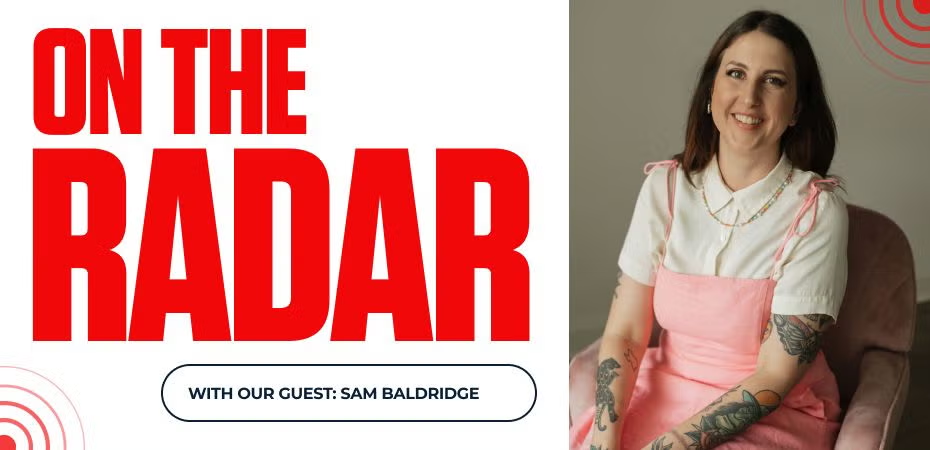
That question was at the center of our recent webinar What’s In, What’s Out and What’s Next for Social Media in 2026. Moderated by Casey Dell’lsola, Senior Account Director at REQ, the conversation brought together Katie Brevoort, Associate Director of Social Media at REQ, Victoria Winstead, Senior Digital Marketing Manager at Red Hat, and Sam Baldridge, Senior Communications and Culture Specialist at Applied Systems to unpack what’s shifting across platforms, what brands need to rethink to cut through the noise, and how AI has influenced both content creation and audience expectations.
Trust Is the New Performance Indicator
For years, social strategy rewarded scale and sophistication — highly produced creative, carefully controlled brand visuals, and content designed to look campaign-ready. But panelists agreed that refinement alone no longer guarantees results.
As Victoria noted during the webinar, “audiences have stopped buying from the loudest brand in the room, and they’ve shifted to the most trustworthy and the most helpful.” In feeds saturated with AI-assisted imagery and templated messaging, overly polished content can signal “advertisement” before it signals value, prompting audiences to scroll past rather than lean in.
Sam reinforced that point, noting that performative authenticity is just as easy to spot, stating: “We’re cosplaying relatability, and it’s just not landing with people.” The implication for brands is clear: trust is no longer a soft brand metric, it is a performance metric, and credibility is now the differentiator.
Engagement Is Replacing Reach as the Measure of Success
As AI-generated content floods feeds and infinite scroll shortens attention spans, traditional growth indicators like impressions and follower count are losing strategic weight. When content volume increases, visibility becomes easier to achieve — but harder to translate into meaningful impact.
Katie captured that tension during the discussion, noting that impressions may put content in front of people, but “you’re seeing it with your eyes, they’re not moving the needle about what people are actually thinking and engaging with your brand.”
That shift in thinking reframes how success is measured. As Victoria put it, “I would so much rather have a thousand people who spend a minute or two with our ideas than have a million people see our logo for a fraction of a second.” In other words, sustained attention now carries more value than fleeting exposure.
Increasingly, brands are prioritizing engagement rate, video watch time and meaningful dialogue — signals that indicate audiences are not just seeing content, but investing attention in it.
People Are More Persuasive Than Brands
As trust and engagement become more central to performance, panelists emphasized another shift: audiences respond more strongly to people than to logos.
User-generated content and employee advocacy are increasingly outperforming traditional brand messaging because they feel credible and personal. As Sam explained, “I can go on our profiles and say we’re the coolest and the best… but it just doesn’t hit the way it does when it’s your advocates sharing it.”
That distinction reflects a broader credibility gap. When customers or employees share experiences in their own voices, the message carries weight that branded copy alone cannot replicate.
Platform-Native Content Is Outperforming Branded Creative
Panelists also highlighted a shift in execution: highly branded creative is increasingly underperforming compared to content that feels native to the platform.
Katie shared that her team has intentionally deprioritized heavily branded posts, particularly those with overt logos or stylized text overlays that feel more like ads than social content. Instead, they’ve leaned into in-app formatting and more conversational creative that blends into the feed rather than interrupting it. Formats like carousels and short-form video designed to be scrollable and shareable are driving stronger engagement.
Looking Ahead
As social media continues to evolve, so too does the lens through which performance is evaluated. For brands navigating both B2C and B2B landscapes, the message from this panel was clear: credibility matters more than volume. Trust, engagement, and advocacy are no longer secondary considerations.
In a feed shaped by AI, personalization and constant content creation, the brands that break through will be those grounded in relevance, consistency, and real human perspective. Substance will outperform spectacle.
You can listen to the full discussion below – or visit the REQ YouTube channel for this and other insights.